
Hi my name’s Nick, and I’m a Devon cyclist.

I learnt to ride on a hand-me-down Raleigh Grifter in Dawlish. Looking at Wikipedia I think it must have been a MK1, and I inherited it from Jim, my youngest older brother. My eldest older brother, JR, had a racing bike, red and white as I recall, hung from the wall in the garage. Its skinny tyres and weird handlebars made it seem like a scary machine, only for accomplished riders, and I never climbed astride the saddle.

I don’t remember much about the Grifter, except that it had three gears and was a rusty red colour, and that there was an incident, coming down a grassy field near where I grew up, at quite some speed; such speed that I lost my nerve and slammed both brakes on at once, when I really should have squeezed the rear one first and then gently put some pressure on the front brake. Needless to say, I went over the handlebars, sans helmet (it was the 80s and we cared little for personal safety back then). Fearing that I was done for, my mate Jonnie ran for his mum, who was a nurse; luckily I was fine, aside from cuts and bruises. (This is a trend that will continue; but more of that later.)

There was a particular circuit I used to like to ride near my house; up the lane at the back of the estate, to the road at the top where I’d cross and head into the forest; from there you’d take a dirt path to the edge of a farmer’s field, which you’d follow for what felt like ages but was probably less than quarter of a mile. Back into the forest, along another trail, over the road again, and onto the trail that ran along the top of the field where I’d lost my nerve; hammer along that trail, dodging rocks and bouncing over partially erupted tree roots. It was amazing.

I didn’t really ride during my teens; the town where I grew up is a valley, and we lived at the top of one side of it. I never fancied forcing my way up the hill homewards on a bicycle, especially one with only three gears. Halfway through university though I decided a bike would be a good way to traverse the anonymous midlands town I was trapped in, and I spent £150 of my student loan on a red mountain bike with full suspension, which helped me explore the nature reserve that bordered our main campus, and meant I didn’t have to rely on the buses to get me from one campus to another and then back to our student house. I don’t think I ever wore a helmet, even though I cycled along main roads. It seems insane to me now.

When I got back from university I only made one significant bike ride; from Dawlish to Exeter one sunny Saturday, in order to impress a girl I’d met who worked in a record shop. I had no idea how to get from one point to the other – just a vague sense that there was a cyclepath alongside most of the river – but I managed it, and it obviously impressed the girl some, because 13 years later we’re married, and there are three bicycles in our house.

Those bicycles took some time to amass, though; I didn’t push a pedal for the best part of a decade, until we got married in 2010, and decided shortly afterwards that we should get bikes via the Cycle To Work scheme (when, I’m afraid Rob, I was 31 rather than 35). That’s when the bug really got hold of me; I’d bought a decent enough flat-bar hybrid for commuting, but soon enough I was taking it out at evenings and on weekends, hammering the estuary trails and eventually going further afield. For while I always rode with one pannier, just in case, even if I was only doing 10 or 15 miles. I’d carry a lock, a pump, tools, a camera, a jacket, and heaven only knows what else. It seems insane to me now.

Within a year I’d ordered a new bike; with skinny-ish tyres and weird handlebars now, almost like my eldest older brother used to have, but not quite; an aluminum cross bike that you could bolt a rack to if you wanted, race through mud or commute really quickly or take on tour if you so wished. I took it over Dartmoor again and again and again, put skinnier tyres on, made it as aggressive as possible, and rode it into the ground until it could take no more (I’m not much – no, I’m not any – of a mechanic). Bitten, and bitten hard, I bought another bike, a proper racing bike this time, and dressed up like a magic marker with lycra shorts and woolen jerseys and cycle-specific socks and pedals that clip to your shoes. When I go out now I take a tiny pump that fits in a pocket on the back of my jersey, and two bottles of lemon squash, and a tiny multitool, and an innertube, and some flapjack, and I ride for 50 miles or more and never need a pannier.

I’d ridden only a few hundred miles before 2010, if that; laps around Dawlish as a kid, and traversing Northampton as a student. Since then I’ve ridden thousands more, and 99% of them have been in Devon. Occasionally I ponder taking a cycling holiday or going touring properly, but when you live somewhere as wonderful to cycle as here is, it seems like a waste of petrol and time to get there; my bike rides start, almost without exception, at my front door, and that’s usually where they end, too.
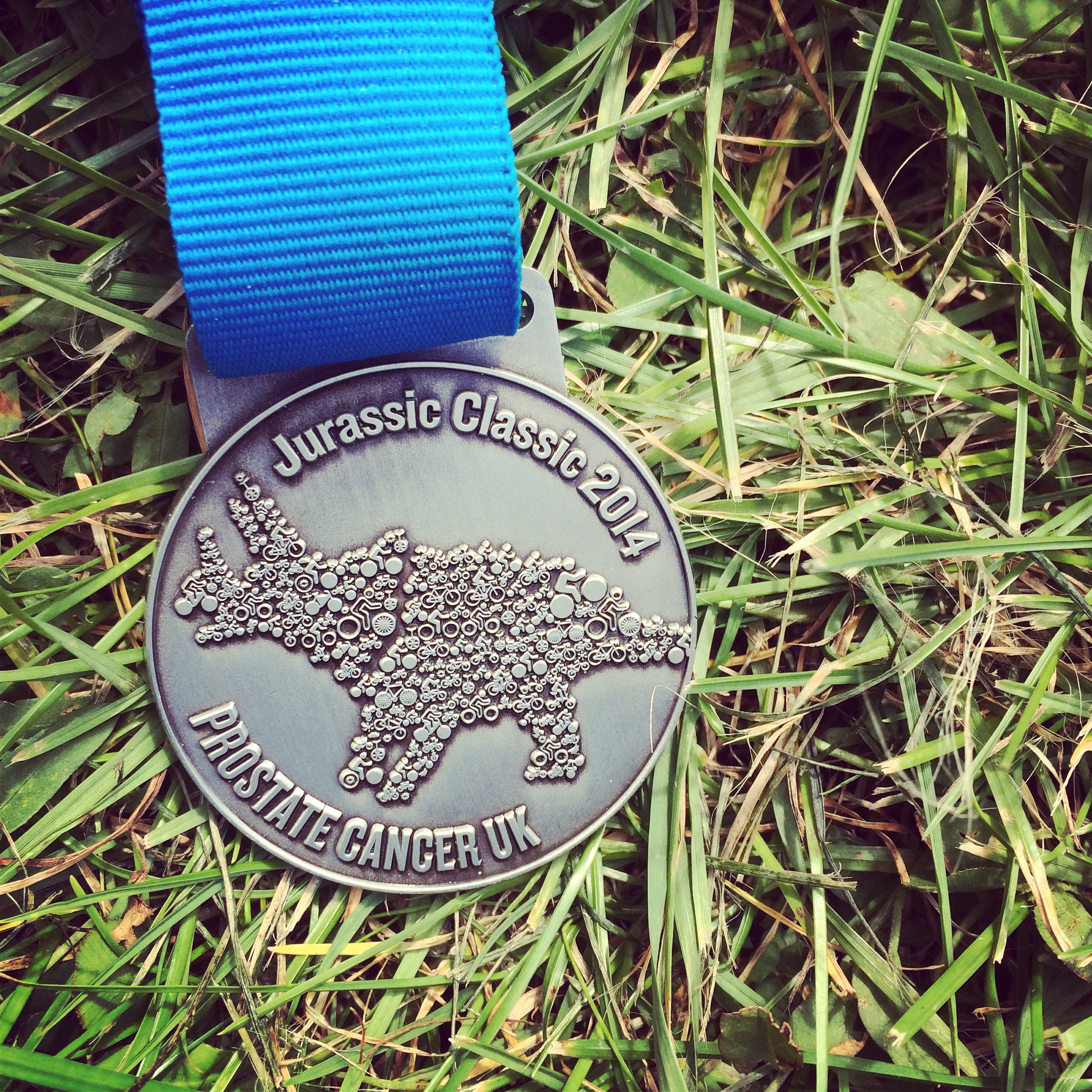
The Jurassic Classic 2014

Jurassic Classic medalThe Jurassic Classic 2014 took place on Sunday 17 August. It’s a sportive offering 60km, 60mile and 100mile routes, beginning in Exmouth and taking in the whole of East Devon. The event is in its third year and, after a troubled start when the 2012 event was postponed after a huge downpour flooded significant parts of the route, the organisers have persevered and now it is a fixture in the Devon cycling calendar.

The Routes

The 100mile ‘Epic’ route blossoms out around the Sid Valley and surrounding areas, beginning with a coastal section from Exmouth through to Branscombe before turning inland and making for the Blackdown Hills, before winding around the East side of Exeter and across Woodbury Common to the finish.

Route maps can be found here: 

100mile 
http://www.bikemap.net/en/route/2760370-jurassic-classic-100mile/

100km 
http://www.bikemap.net/en/route/2760374-jurassic-classic-100km/

50km 
http://www.bikemap.net/en/route/2760376-jurassic-classic-50km-route/

It’s a challenge, or at least it seemed so to me. The 100mile route takes in more than 7000ft of climbing, in a combination of sharp inclines like Salcombe Hill in Sidmouth and the climb out of Branscombe and longer slogs, such as the road from Honiton up to Dunkeswell at the top of the Blackdown Hills. Most of the toughest climbs are out of the way within the first 50 miles, but the remainder of the route still has its fair share of sapping gradients, which seem doubly draining when endured after the ups and downs of the first half. The Exmoor Beast claims 6165 ft of climbing for its 100 mile route, which is a useful if daunting comparison.

The scenery is beautiful and carries a little extra magic due to the ‘hidden’ feel that some of the route has. It feels like an exploration, and the route itself seems designed to criss-cross as much terrain as possible. Very little is on busy roads and riders will find themselves snaking through woodlands atop the Blackdowns, venturing into and out of the apparently secret valley that nestles between the River Sid and the River Coly and otherwise tearing along as if they were out for a Sunday blast, alone in paradise. 

The Event

The event itself was smaller than the big Devon sportives, the Dartmoor Classic and the Exmoor Beast, but still managed to persuade over 500 people around the testing terrain. The previous two years have run more than 1000 around the route. It certainly felt quiet as the twists and turns of the East Devon countryside absorbed the riders effortlessly. No fighting to push past other riders with cars pressing you from behind and no sense that you may be holding up 35 members of the Exeter Wheelers as they wait for a straight to get past you and back on target for gold classification. 

The 100 mile route had good signage and 3 feeding stations, at 35, 65 and 93 miles. As befits the lower-key feel of the event, these were stocked with fruit, flapjacks and lots of homemade cake, with the ladies of the Gittisham and Aylesbeare village halls serving tea in china cups. I confess that I had expected the timing mats which were in place at 2 of the 3 to stop the clock. My time when I finally crossed the finish line was about 35 minutes more than my time as recorded by Strava, which included me pausing at each feed station. Had I clocked my Strava time then I would have made the silver classification, and been delighted, but I’m a relative newcomer to sportives, so perhaps this is standard.

The organisation was good enough, and I don’t mean that perjoratively. The event is staged to raise money for Prostate Cancer UK and so trestle tables and Women’s Institute cakes instead of sponsors tents and sports nutrition promotions are just fine by me. The team managed to get us all away and, as far as I know, we all came back. They did it with what felt like a light touch, and that’s fine by me. We were here to ride.

Me

Cycling is man’s most efficient form of self-powered existential crisis. I entered the Jurassic Classic for two reasons. Firstly, and mostly, because it connects together all the bits of cycling that I do the most, that I love the most, that I know the most. I wanted to complete it as some sort of tying together, a tribute to the landscape that had turned me into a cyclist. Secondly, because it’s been 2 or maybe 3 years since I rode 100 miles in a day and I wanted to do it again.

I knew in the run-up, and as I sat at the starting gate at 7am, that I would begin the ride thinking about the many times I had ridden those lanes before and taking comfort from the knowledge that I could climb the ups and negotiate the downs. I also knew that no matter how confident I felt, no matter how much I told myself that I knew every twist and turn, that I had this one, that I would find myself at some point in the third or fourth quarter of the ride deeply wondering whether I had taken too much on. I also knew that this would be preceded by a couple of hours in the psychological washing machine. 

Long distance cycling, whether with a group or alone – and in this case I was both, having set out with 500 other riders to do the route on my own – is a singular mental experience, in my view at least. To spend 7 hours alone with your own thoughts and to have those thoughts sliced into tiny pieces and flung around as if in a snow globe with snatches of music and lines from recent conversations and random voices you can’t control, all of which begin to form a coalition of doubt over to your ability to keep your legs turning over and over and over for the next 4 hours. 

Well, all that happened. And as the worst of it was kicking in, so did one of the two brief, cold rain showers. So did the climb up the Blackdowns and minutes later I was fighting a looming faint.

Otherwise, riding this event on home territory was everything I’d hoped it would be. It’s beautiful but I didn’t need reminding of that. I’m lucky enough to live here. Knowing what was coming, good or bad, and knowing that you had climbed it before, picked your way between these points before, really helped with the mental heavy-lifting and just being able to orient myself in the countryside and understand how far along I was without a computer (which I leave at home these days) or distance markers (which didn’t feature) helped to settle the mind and bolster the legs.

When I did speak to people it was to reassure them that they were nearly at the top of some particular climb, or that there was a rewarding descent around the corner. I felt, briefly, like a guide.

Otherwise the sportive format is, for someone who has little or no grasp of cycling technique, a great reminder of how different we all are as riders. To watch riders slowly group together and then slowly separate as they go is fascinating, albeit always inconclusive for a dim bulb like me. The always-undulating terrain of East Devon provides constant opportunities for observation. Why is that guy drifting ahead of me on the short inclines but falling behind on the longs? And how come I put a good quarter mile between me and this chap and yet now he’s back with me? Am I fading? Is he doping? What should I be doing differently?

I finished happy and strong, still able to hammer the down into Exmouth once I knew Woodbury was behind me. 

Vignettes

A guy I had earlier followed the wrong way through a priority sign, attracting the ire of one of the huffier Sidmothians, arrives at the 64-mile feed stop, catches my eye and says, in a sharp Northern Irish accent, “It’s been emotional. My body’s built for comfort not climbing fukken hills like these…”

The two guys in matching shirts ahead of me as I start climbing Salcombe Hill have been just the sort I envy. Apparently making progress solidly without pain, I imagine they must complete events like this most weekends. But what do I know about what they’re feeling? Half way up one of them falls off. “I took the gradient out of it then next thing I knew the front wheel had gone from under me!” He precedes to dust himself off and begin to walk, still ahead if his mate and me. As I pass them both, the one still riding asks whether we are near the top. I say, “Yes,” but it’s all relative.

Halfway up the climb out of Colyton I pass two grey-haired tourers, laden with panniers and, I deduce, not participating in a 100-mile sportive. They are having trouble with one of their bikes. I look at the gradient, look at the other riders, think about the gradient and the time and realise I have to stop. “Are you guys okay?” “No,” the woman replies with what I will later decide was a strong Dutch lilt. “He is damaged.” She has a look on her face half way between despair at being stuck with a broken bike in the middle of the unfamiliar countryside and despair at having a husband so weak as to become damaged. I point them back down the hill and tell them if they head for the School they will find a whole bunch of people who know a whole bunch about bikes and who will help them, and possibly give them free cake. They seem happy. I head up the hill again and 15 seconds later pass a chap I work with, just out for his Sunday ride.   

In conclusion

Riding an event like this where you live adds something significant. I know many cyclists baulk at the idea of paying to ride the routes they take for free the rest of the year round, but that’s short-sighted. The money, in this case at least, goes to a good cause, and you get the rare chance to experience those roads anew, and to welcome others to them.

So, check out your local events listings, ride your local sportive and then, next year, come and ride mine, the Jurassic Classic.

I’m Rob and I ride my bike in Devon

Without Devon I wouldn’t be a cyclist at all. You might think it a quirk of timing. Maybe I just happened to be living here when I hit the age when many find themselves drawn back to two wheels (it’s 35, face it). You might be right. But I’m pretty sure that without the boundless charm, verdant beauty and pure pleasure of this county, my bike riding would have been either a short-lived dalliance or a grim persistence. Instead it’s become a love affair, a marriage you might say, with all the challenges and rewards that implies.

It began in 2005 or so, just over a year after we moved here. Friends we’d made turned out to be mountain bikers and so we tagged along, at some point buying ourselves what seemed at the time like expensive hard tails. £500 each as I recall. We rode in the Quantocks, on Dartmoor, Woodbury and Exmoor. I can barely remember those early rides. I never once asked how far we’d ridden, how much climbing we’d done. Now we could join in now whenever biking friends were down this way. I remember slogging around Dunkery and Dunster after my friend Andy, a veteran – to me a pioneer – of 24 hour solo races and 6 month cycle tours, and his wife Liz, a crushingly persistent pedaller. We enjoyed spending time with our fiends doing something new and mountain biking is fun.

Then one day, I reckon in 2006, I found myself wondering whether it would be possible to ride my bike to work. I’m not sure what the catalyst for that initial thought was. I don’t recall it being Ride To Work day or some similar initiative. I think the idea just occurred to me and wouldn’t be shaken. So I did it. I had no idea whatsoever how long the ride was or how long it would take. In fact, had I known how long the ride was going to be, I still wouldn’t have known how long it was likely to take me. Days of pushing to average 15mph or better on my commute were a way off yet. My calculations got no more sophisticated than thinking it took roughly an hour to drive door to door, and a car was probably at least 3 times as fast as a bike, so it would take me at least 3 hours. I actually thought it would be more like half a day.

I set off with a route planned out which would take me through places i’d never been before, along roads I’d never driven. It felt like an expedition, an adventure. I had an ordnance survey map with me and enough stuff in my rucksack to survive for a week if I happened to get stranded in the middle of the wilderness. It was a tough ride, as I recall. I’ve since discovered that every ride in Devon is a tough ride, pretty much. I had to stop often to check the map. I climbed hills and descended and slogged on. And slowly but steadily the places I’d picked out on the map began to connect up. An hour and three quarters later, I arrived in Exeter. I’d ridden 17 miles. It felt like a triumph, and it was. This was the first of a handful of times I’ve got on my bike to go somewhere genuinely unsure whether I would be able to make it. But i’d gone anyway, trusting myself.

The year after that my employer began to offer the Cycle to Work scheme and I started to wonder whether I could actually make the trip more often. I used that as a pretext for buying my first road bike, a Marin Lucas Valley. Essentially it’s a hybrid, supposedly designed by one of the company’s head honchos as the perfect bike for his ride to Marin HQ each day. There have been some times during the intervening period when i’ve wondered whether that was the right choice. Should I have gone for one of the tricross bikes I also tested? Should I have gone for a pure road bike? These thoughts most often tumble around when i’m trailing someone up a big hill and looking at the leaner lines of their bike as they slowly stretch out ahead of me.

But for the rest of the past 7 years i’ve just had a blast with it. It’s this bike that really got me. I would get up with the larks on Sunday mornings and pound up and down the valleys of East Devon, ploughing into the early morning mists, sliding over frozen farm slurry, crunching down baking lanes of indeterminate surface. For at least one Summer I rode to work and back 2 to 3 times each week and loved it, both the in-the-moment experience and the fact that I was actually doing it. I rode it over Dartmoor, did 100 miles in a day with my friend Tom – another of those spins into the unknown – rode small events here and there, and eventually built up to taking the thing all the way up to John O’Groats.

I loved the bike and still do, but even more, I loved where it took me. Devon is a stunning place to live and work. We moved down here from Manchester for that very reason, but until I started to sortie through its lanes, I didn’t know it at all. Fields, hill, farms, valleys, rivers, moors all seen through the windscreen were largely abstract until I went at them on my bike. Through my bike, I found a home here.

Without Devon I wouldn’t be a cyclist. Without cycling, I wouldn’t know Devon at all.